

 Back to the journal
What Is Data Annotation? Types, Examples and Uses in AI
Short answer: data annotation is the process of adding labels or marks to raw data, such as images, video, text, audio or 3D scans, so a machine learning model can learn what that data contains. A labeled example might be a box around every car in a photo, a tag saying a review is negative, or the start and end time of a spoken word. Models learn patterns from thousands of these examples.
Why AI needs annotated data
Most production AI models learn by example (supervised learning). A model cannot know that a group of pixels is a pedestrian until it has seen many images where people marked pedestrians. The labels are the "answers" the model studies. If the answers are wrong or inconsistent, the model learns the wrong thing, no matter how good the algorithm is.
Annotated data is used to:
- train a model (most of the data);
- validate it while tuning;
- test it on examples it has never seen, to measure real performance.
The main types of data annotation
| Data type | Common annotation types | Example use |
|---|---|---|
| Images | Classification, bounding boxes, polygons, segmentation masks, keypoints | Defect detection, retail shelf monitoring, medical imaging |
| Video | Object tracking, action and event spans, pose over time | Driver monitoring, sports analytics, robotics |
| Egocentric video | Hand-object interaction, action steps, hand keypoints | Robot learning, assembly verification |
| 3D / LiDAR | 3D cuboids, point segmentation, sensor fusion | Autonomous driving, mapping |
| Text | Classification, named entities, intent, sentiment, preference ranking | Chatbots, search, LLM training |
| Audio | Transcription, speaker diarization, sound events | Voice assistants, call analytics |
| Documents | Fields, tables, key-value pairs, reading order | Invoice and form processing (OCR) |
Examples of data annotation
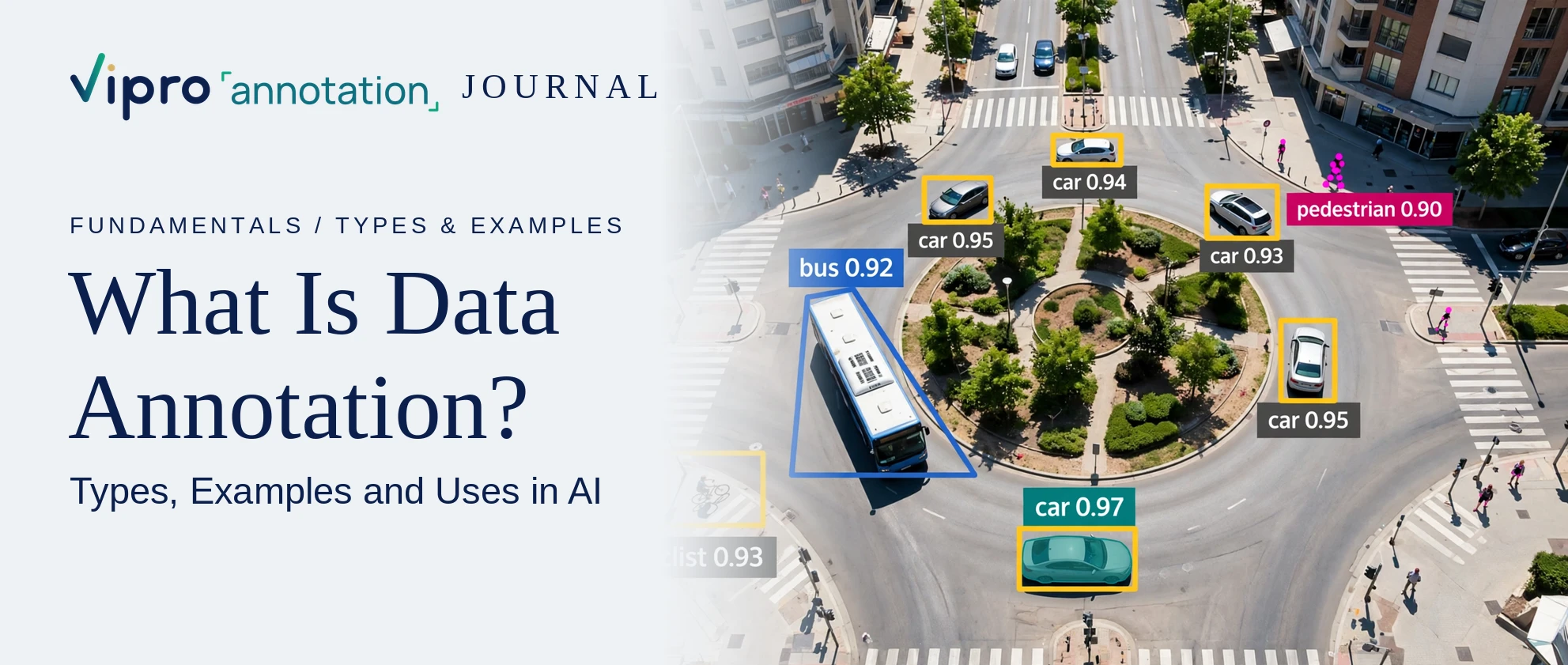
- Self-driving perception: every car, pedestrian and cyclist in a camera frame gets a box; the same objects get 3D cuboids in the LiDAR scan.
- Manufacturing quality: scratches and dents are outlined with polygons and given a severity class.
- Customer support AI: each message is tagged with an intent such as "refund request" or "delivery delay".
- Large language models: reviewers rank two model answers and explain which one is more accurate and helpful.
- Speech recognition: audio is transcribed word by word with timestamps and speaker turns.
Who does data annotation?
Annotation is done by in-house teams, crowdsourcing platforms, or managed annotation providers. Complex or sensitive work usually needs trained annotators who follow a written rulebook, with reviewers checking their output. Software can pre-label simple cases, but people still review edge cases and approve final labels.
How annotation quality is checked
- Written guidelines with examples of every class and edge case.
- Calibration rounds where annotators label the same items and compare results.
- Review passes on a sample or on every item.
- Agreement metrics such as Cohen's kappa or IoU.
- Gold sets of items with known correct answers.
Is data annotation the same as data labeling?
Mostly yes. The terms are used as synonyms; some people use "labeling" for whole-item tags and "annotation" for detailed marks inside the item. See data annotation vs data labeling.
Is data annotation done by AI now?
Partly. Models can pre-label data and speed up simple work, but human review is still needed for edge cases, new classes and final quality checks, especially when errors are costly.
Have a dataset in mind?
Start with a Free Calibration Pilot