

 Back to the journal
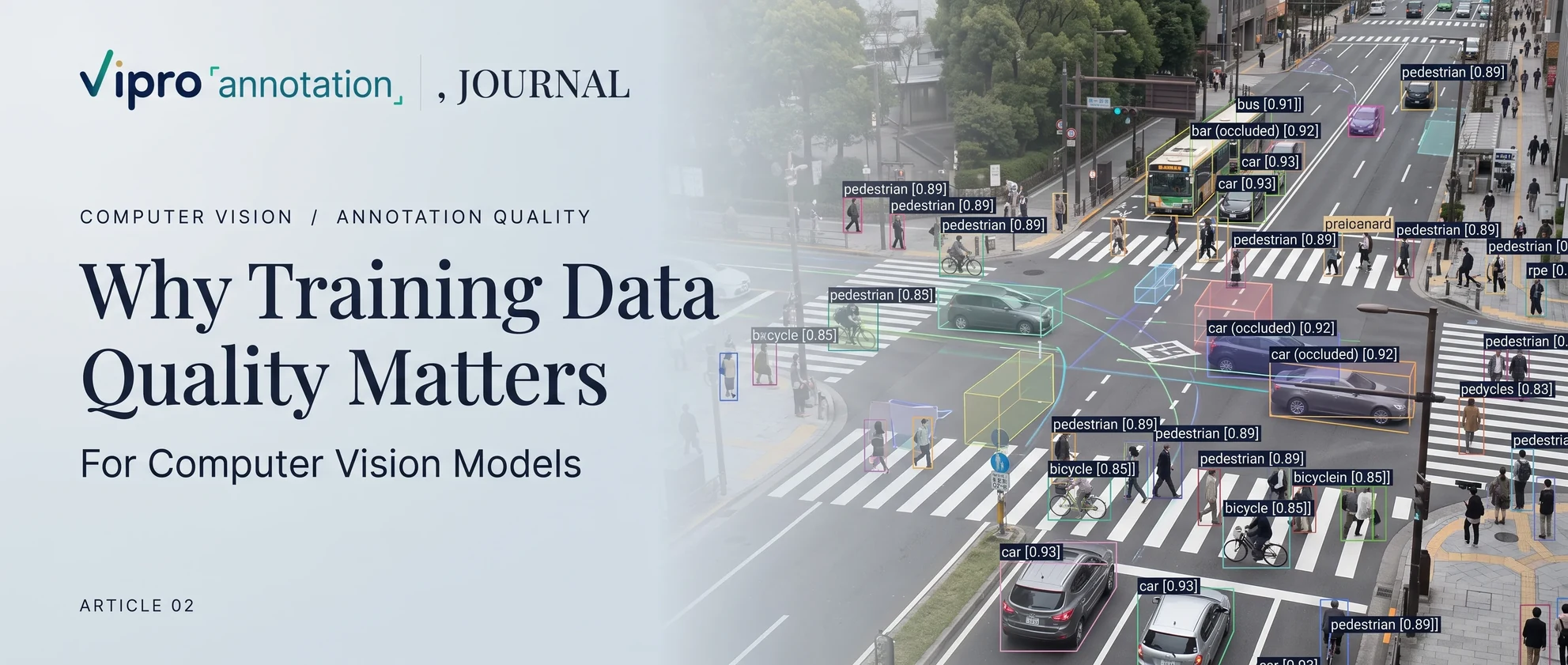
Why Training Data Quality Matters for Computer Vision Models
Better models do not begin with better algorithms. They begin with better examples.
A computer vision model can only learn from the information its training data provides.
A model may have a powerful architecture, a large dataset, and a carefully designed training process. But if the underlying data contains inconsistent or incorrect annotations, the model is learning from imperfect examples.
This is why training data quality matters.
Computer vision models learn patterns from labeled examples. If those examples consistently represent objects, actions, boundaries, and classes correctly, the model has a stronger foundation for learning.
If the examples contain missing labels, incorrect classes, inconsistent boundaries, or broken object tracks, those problems can become part of what the model learns.
The goal is not simply to create more data.
The goal is to create reliable AI training data.
The model learns what the dataset shows it
A computer vision model does not know which annotation is correct and which one is a mistake.
It learns from the examples it receives.
Consider an image containing a vehicle.
If the vehicle is consistently identified with an accurate bounding box, the model receives a clear example of what that object looks like and where it appears.
Now imagine that similar vehicles are sometimes missed, sometimes assigned to another class, and sometimes surrounded by inconsistent boundaries.
The dataset is no longer giving the model one consistent lesson.
This is where image annotation services become important.
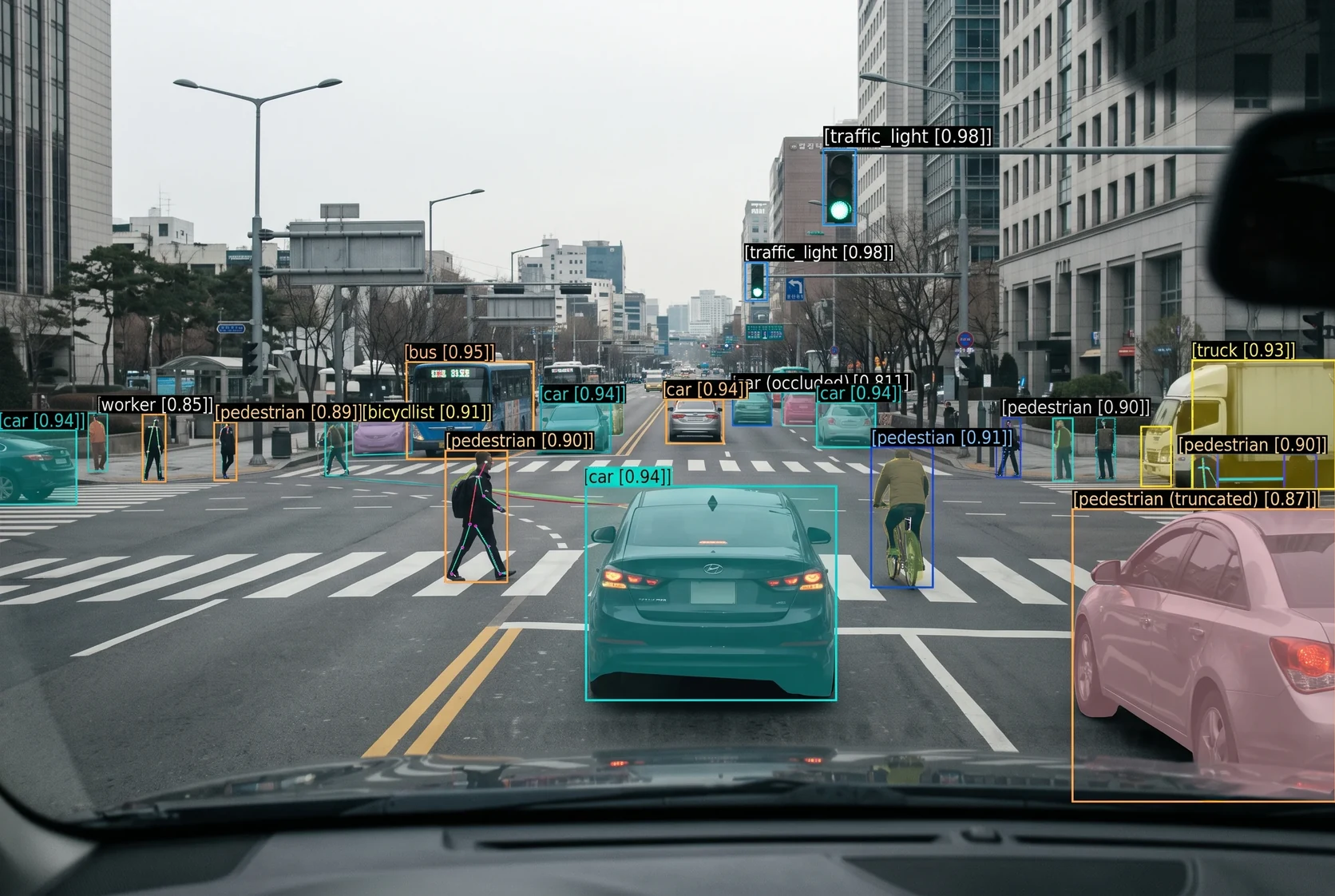
Bounding box annotation can identify an object's location.
Polygon annotation can describe more complex object boundaries.
Semantic segmentation can identify pixels belonging to a class.
Instance segmentation can distinguish individual objects.
Keypoint annotation can identify important points on a person or object.
Image classification can assign a class to an entire image.
The annotation method changes according to what the model needs to learn.
The dataset should represent the information the model is expected to learn.
Small annotation errors become larger problems
One incorrect annotation may appear insignificant.
A missing object in one image may not seem important.
A slightly incorrect boundary may appear harmless.
But when the same problem appears repeatedly across a large dataset, the effect can become much more significant.
Common annotation problems
Missing annotations — An object is present but is not labeled.
Incorrect annotations — An object receives the wrong class.
Inconsistent boundaries — Similar objects are represented differently by different annotators.
Duplicate annotations — The same object receives more than one annotation.
Broken tracking — An object loses its identity between frames.
For video projects, video annotation services may involve object tracking, multi-object tracking, frame-by-frame annotation, action recognition, and event tagging.
A tracking error can therefore affect more than one frame.
A single inconsistent decision can continue through a sequence.
A small annotation error can become a large training-data problem when the same decision is repeated at scale.
Quality means more than correct labels
A high-quality dataset is not simply a dataset with a large number of completed labels.
Quality involves how accurately, consistently, and completely the information represents the intended task.
To see how consistency between annotators is measured, read inter-annotator agreement explained.
A strong annotation workflow considers:
Accuracy Are the annotations correct?
Completeness Are the relevant objects and events represented?
Consistency Are similar situations treated in the same way?
Geometry Do the annotations correctly represent object boundaries and positions?
Class consistency Are similar objects assigned the same class?
Guideline compliance Are the annotations following the defined rules?
This is where annotation guidelines become important.
Annotators need a shared understanding of how difficult situations should be handled.
Occlusion. Small objects. Overlapping objects. Motion blur. Unclear boundaries. Unusual viewpoints.
These situations can create different decisions if the rules are not clearly defined.
A strong annotation workflow therefore combines human-in-the-loop annotation with annotation quality assurance.
Human review can identify patterns that automated checks may not capture.
Quality assurance can identify missing annotations, inconsistent labels, boundary problems, and other issues before they become part of the final dataset.
And sometimes disagreement is useful.
If two trained annotators repeatedly disagree about the same situation, it may indicate that the annotation rule itself needs to be improved.
Quality is not simply about finding mistakes. It is about creating consistent decisions that a model can learn from.
Build training data quality into production
Training data quality should not be treated as a final inspection.
It should be part of the workflow from the beginning.
A practical process can look like this:
01 — Define the objective Determine what the computer vision model needs to learn.
02 — Establish annotation guidelines Define classes, boundaries, attributes, visibility, and difficult cases.
03 — Create a calibration set Use representative examples to test whether annotators interpret the guidelines consistently.
04 — Begin annotation Apply the agreed rules across the dataset.
05 — Perform quality assurance Review annotations for accuracy, completeness, consistency, and guideline compliance.
06 — Correct recurring issues Identify patterns rather than correcting isolated errors only.
07 — Validate the dataset Confirm that the final machine learning datasets meet the requirements of the intended model.
This process helps move quality from an end-of-project activity into an ongoing part of annotation.
Quality needs to survive real-world conditions
Computer vision models are eventually expected to work beyond the clean examples used during development.
A dataset may need to represent:
Different lighting conditions
Different camera positions
Occlusion
Crowded scenes
Small objects
Motion
Different environments
Difficult visual conditions
The training data should therefore reflect the conditions in which the model is expected to operate.
This is especially important for projects involving autonomous driving annotation, ADAS training data, medical image annotation, aerial imagery annotation, agriculture AI data, manufacturing defect detection, and sports analytics annotation.
Different applications have different requirements.
The underlying principle remains the same:
The quality of the training data determines the quality of the examples available to the model.
From image annotation services and video annotation services to object tracking, segmentation, keypoints, and classification, reliable annotation can help create structured AI training data for computer vision models.
Read next: How to write annotation guidelines annotators follow
Have a dataset in mind?
Let’s talk