

 Back to the journal
Image Classification vs Object Detection vs Segmentation
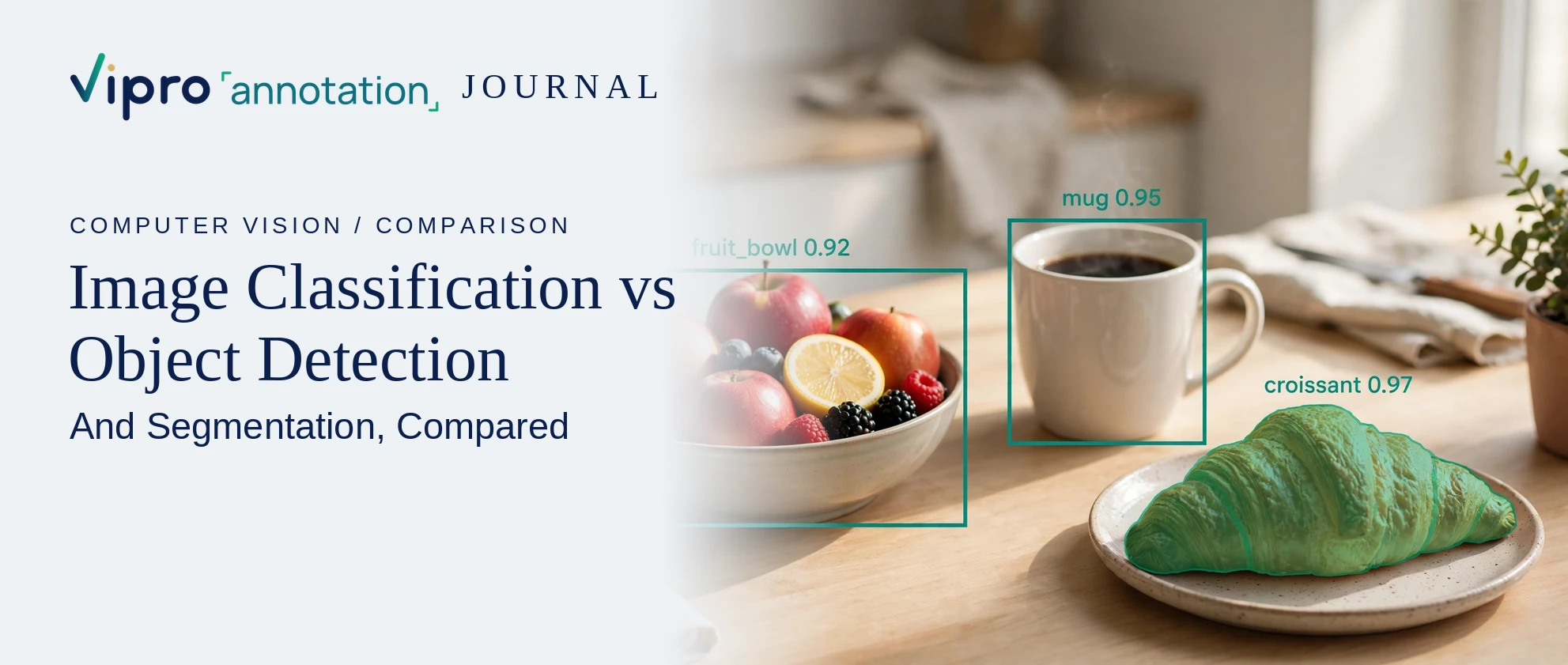
Short answer: image classification says what an image contains (one label per image). Object detection finds where each object is (a box and a class per object). Segmentation marks the exact pixels of each object or region. Each task needs a different kind of label, and the label effort rises in that order.
The three tasks side by side
| Classification | Object detection | Segmentation | |
|---|---|---|---|
| Question answered | What is in this image? | What is where? | Exactly which pixels? |
| Model output | Class label(s) | Boxes + classes | Masks + classes |
| Label needed | One tag per image | Box per object | Polygon or mask per object/region |
| Labeling effort | Lowest | Medium | Highest |
| Example | "Defect" / "No defect" | Box around each scratch | Exact outline of each scratch |
Image classification
The model looks at the whole image and outputs one class (or several, for multi-label tasks).
Good for: sorting images, quality pass/fail, content moderation, scene type (indoor, outdoor, night).
Labeling tip: define what to do with images that contain more than one class, and add an "unclear" option.
Object detection
The model draws a box around each object and names it. It can count objects and say roughly where they are.
Good for: vehicles and pedestrians, products on shelves, people counting, PPE checks.
Labeling tip: agree on box tightness, minimum object size, and how to box partly hidden objects.
Segmentation
The model assigns pixels to classes (semantic) or to individual objects (instance), or both (panoptic).
Good for: drivable area, medical regions, defects measured by area, robot grasping.
Labeling tip: write boundary rules for edges, shadows and reflections; check agreement with mask IoU.
How to choose
- Do you need location? No: classification. Yes: detection or segmentation.
- Does exact shape or area matter? No: detection. Yes: segmentation.
- How much budget and time do you have? Start with the simplest task that solves the problem, then add detail only where the model needs it.
Can one dataset serve all three?
Partly. Masks can be turned into boxes, and boxes can be turned into image-level tags, but not the other way round. If you may need segmentation later, label masks for at least a subset now.
Have a dataset in mind?
Start with a Free Calibration Pilot