

 Back to the journal
Data Annotation vs Data Labeling: What's the Difference?
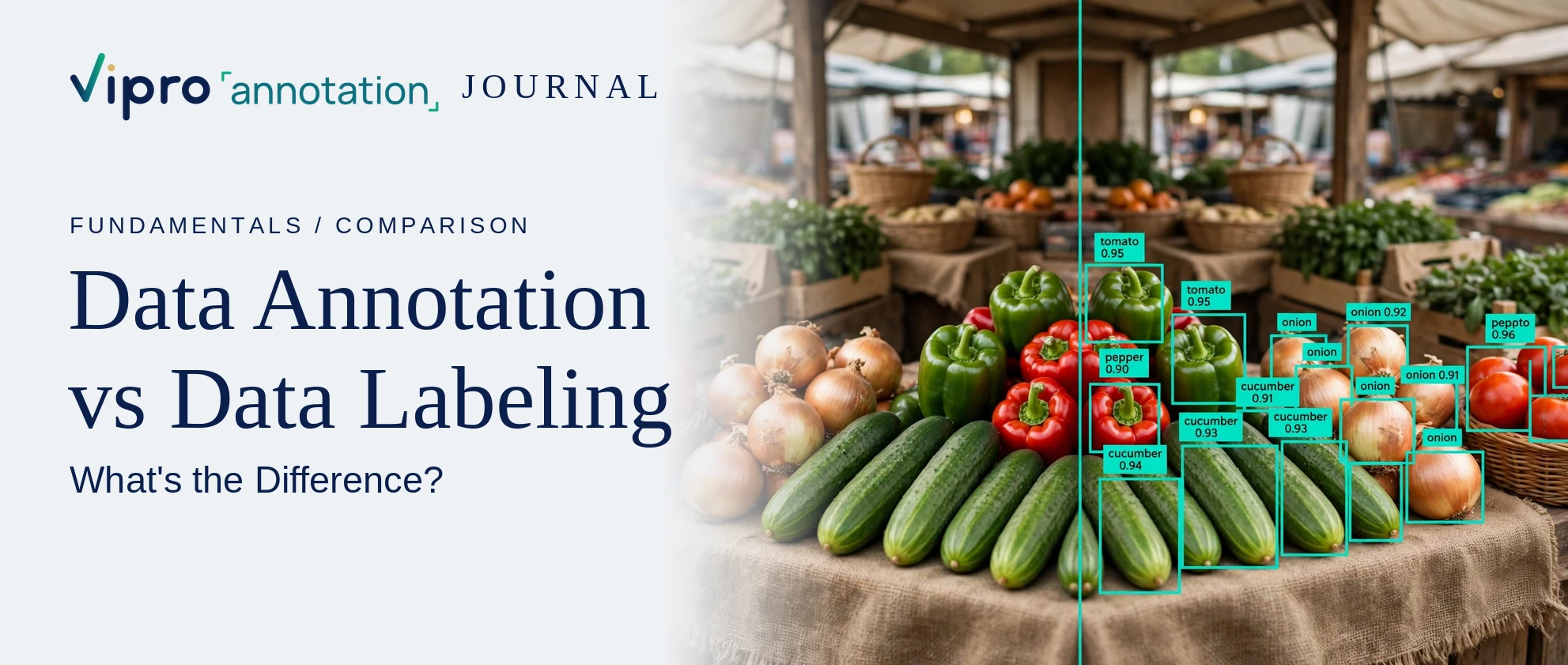
Short answer: in day-to-day AI work, data annotation and data labeling mean almost the same thing: adding information to raw data so a machine learning model can learn from it. When people do separate them, "labeling" usually means assigning a class or tag to a whole item, while "annotation" covers richer marks inside the item, such as boxes, outlines, keypoints, timestamps or relationships.
Why the two terms get mixed up
Both words describe the same job: a person (often helped by software) looks at raw data and records what is in it. The industry never agreed on strict definitions, so vendors, tools and research papers use the terms interchangeably. You will see "image labeling tool" and "image annotation tool" describing the same product.
That is fine for conversation. It matters more when you write a statement of work, because the word you choose can hide how much effort a task really needs.
A practical way to separate them
| Labeling (narrow sense) | Annotation (broad sense) | |
|---|---|---|
| What is marked | The whole item | Parts inside the item |
| Typical output | One class per image, clip, sentence or file | Coordinates, masks, spans, timestamps, links |
| Example (image) | "Contains a forklift: yes" | A box or polygon around each forklift |
| Example (text) | "Sentiment: negative" | Named entities marked inside the sentence |
| Example (video) | "Clip shows assembly" | Start and end time of each assembly step |
| Effort per item | Usually low | Usually higher, varies by detail |
In short: every label is a kind of annotation, but many annotations are much more than a label.
Common annotation types by data type
- Images: classification tags, bounding boxes, polygons, semantic and instance segmentation masks, keypoints for pose or landmarks.
- Video: everything above, plus object tracking across frames, action or event spans with start and end times, and frame-level attributes.
- 3D and LiDAR: 3D cuboids, point-level segmentation, and links between camera and LiDAR views.
- Text: document classes, named entities, intent, sentiment, relations between entities, and preference rankings for large language models.
- Audio: transcripts with timestamps, speaker turns (diarization), and acoustic event tags.
Why the difference matters when you hire a vendor
If a brief says "label 50,000 images", one vendor may quote for a single tag per image while another quotes for a polygon around every object. Both are "labeling" in casual speech, but the effort, cost and turnaround are very different.
Before you compare quotes, write down:
- The exact output format (for example COCO JSON with polygons, or a CSV of class tags).
- The classes and edge-case rules: what counts as a "car" when only part of it is visible?
- The level of detail: tight polygons or loose boxes, every object or only objects above a minimum size.
- How quality will be checked: sample review, second-pass review, agreement between annotators, or a gold set.
A short written rulebook removes most of the ambiguity, whichever word you use.
Is "data tagging" the same thing?
Usually yes. "Tagging" tends to describe simple labels or keywords on whole items, closer to the narrow sense of labeling above.
What is human-in-the-loop annotation?
It means software proposes labels (for example a model draws first-pass boxes) and people review, correct and approve them. It can speed up simple, repetitive work, but human review stays essential for edge cases and for the final quality check.
Key takeaways
- The terms are mostly synonyms; do not let wording decide your scope.
- Define the output, classes, detail level and QA method in writing.
- Compare vendor quotes only after both sides read the same rulebook.
Have a dataset in mind?
Start with a Free Calibration Pilot