

 Back to the journal
How Does Data Annotation Work?
Before an AI model can recognize a person, understand an object, or follow an action, someone has to teach it what to look for.
Data annotation works by adding meaningful information to raw data, such as boxes, outlines, classes or tracks, so that machine learning models can learn from it. A team agrees the labelling rules first, annotates against them, reviews quality, and delivers a structured dataset for AI training.
The process in steps
- Make the annotation decisions before labeling begins: what to label, which classes to use and how to handle edge cases.
- Annotate the raw images or videos against those rules.
- Review quality, so the annotations are accurate and consistent.
- Assemble the reviewed labels into a structured dataset.
- Validate the dataset and use it for AI training.
From raw data to something AI can understand
A folder full of images is not yet a training dataset. A collection of videos is not automatically useful to a computer vision model. Before AI can learn from visual data, someone has to tell the model what it is looking at.
That is where data annotation begins.
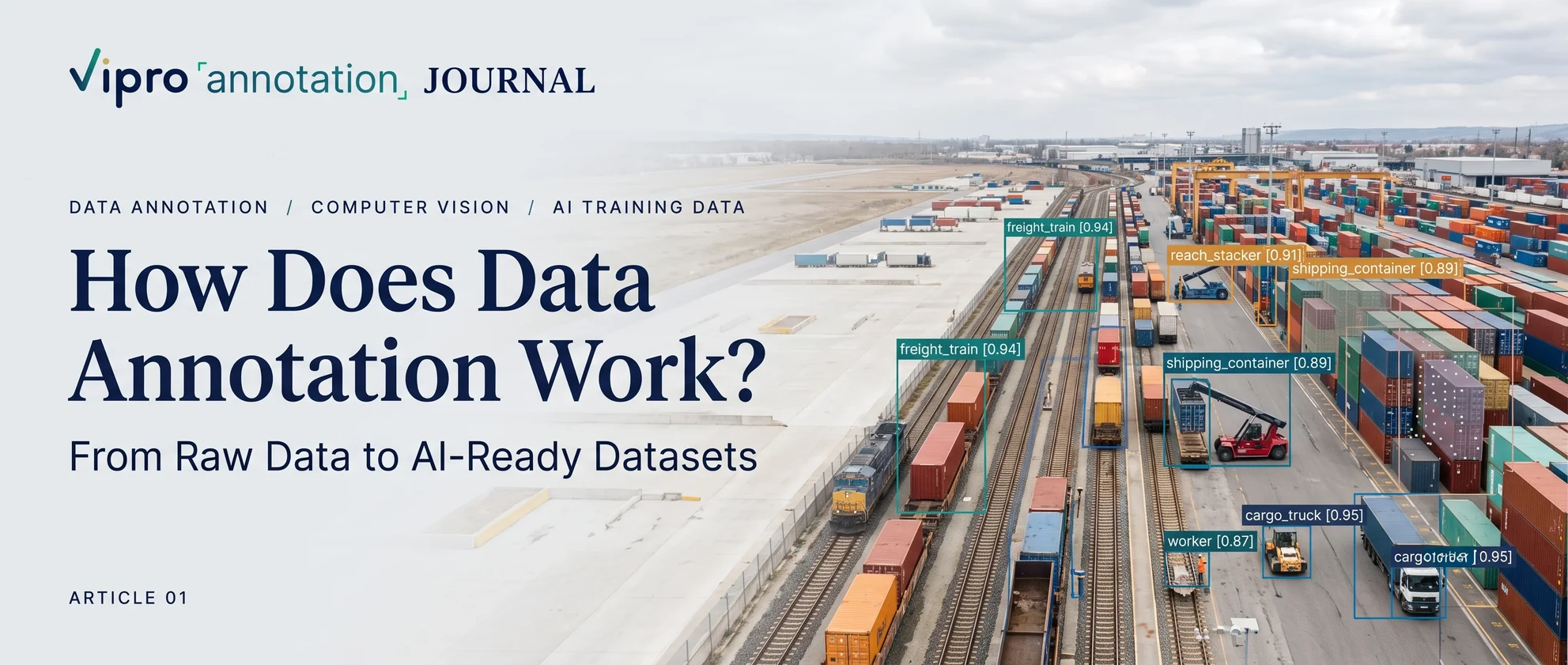
Annotation is the process of adding meaningful information to raw data so that machine learning models can learn from it. In an image, that might mean drawing a bounding box around a car. In a video, it might mean following a person across hundreds of frames. In a segmentation project, it could mean outlining the exact pixels belonging to an object.
The annotation itself may look simple. The decisions behind it are not.
Consider an image of a busy road. There may be cars, pedestrians, bicycles, traffic lights, road signs, and partially hidden objects. If the goal is to train an object detection model, the team needs to decide what should be labeled, which objects belong to which classes, and how difficult cases should be handled.
Raw data → Annotation → Quality review → Structured dataset → AI training
The quality of every step affects what the model eventually learns.

Make the annotation decisions before the labeling begins
Good annotation starts before the first label is drawn.
Before an annotation team opens its first image or video frame, the project needs a clear definition of what should be labeled and how it should be labeled.
This is often called the annotation guideline, labeling guideline, or annotation specification.
It answers questions that may seem small at first:
Should a partially visible car be labeled?
Where should the bounding box end when an object is hidden?
Should a reflection count as another object?
What happens when two classes look similar?
Should a person's visible body be labeled when part of them is outside the frame?
What should an annotator do when the correct answer is uncertain?
Without clear answers, two annotators can look at exactly the same image and produce two different datasets.
That inconsistency becomes a problem when the annotations are eventually used to train a model.
The annotation workflow needs a shared language
A strong annotation project therefore begins with an agreed ontology—the classes, attributes, and relationships that define the dataset.
For example, a pedestrian detection project might contain:
Person
Bicycle
Car
Truck
Motorcycle
But defining the class names is only the beginning.
The team may also need rules for:
Occlusion
Truncation
Visibility
Object boundaries
Overlapping objects
Difficult or ambiguous cases
Minimum object size
Image or frame quality
The goal is not to remove every difficult example. The goal is to make sure difficult examples are handled consistently.
“Good annotation starts before the first label is drawn.”
A well-defined guideline gives annotators a common decision-making framework. It also gives reviewers something objective against which the work can be checked.
Quality turns annotations into training data
A dataset can contain thousands—or even millions—of annotations and still be unreliable.
Quantity does not automatically create quality.
An annotation may be technically present but still be incorrect. An object can be missed. A class can be assigned incorrectly. A boundary can be drawn too loosely. The same situation can be interpreted differently by different annotators.
These errors become especially important when they are repeated.
One incorrect label may have little impact on its own. A pattern of incorrect labels can teach a model the wrong pattern.
What does annotation quality actually mean?
Quality can involve several dimensions:
Accuracy — Is the annotation correct?
Completeness — Were all relevant objects or events labeled?
Consistency — Would another trained annotator make the same decision?
Geometric precision — Does the annotation accurately represent the object's location or boundary?
Class consistency — Are similar objects assigned the same class throughout the dataset?
Guideline compliance — Does the annotation follow the project's defined rules?
This is why professional annotation workflows usually include quality assurance and review, rather than simply assuming that completed annotations are correct.
A reviewer may inspect a sample of frames, compare annotations against project rules, identify recurring errors, and send corrections back into the workflow.
And sometimes, disagreement is useful.
If two experienced annotators repeatedly disagree about the same situation, the problem may not be the annotators.
It may be the guideline.
“An annotation disagreement is sometimes a dataset decision waiting to be defined.”
The strongest annotation projects use these disagreements to improve their rules, examples, and calibration process.
From labeled data to an AI-ready dataset
Annotation is not necessarily the final step.
Once the labeling work is completed, the dataset still needs to pass through review and validation before it becomes ready for model development.
A typical workflow can look like this:
1. Raw data collection Images, videos, or other source data are gathered according to the project requirements.
2. Annotation planning Classes, attributes, tools, guidelines, and edge cases are defined.
3. Annotation Annotators label the data according to those rules.
4. Quality assurance Samples or completed work are reviewed for missing, incorrect, inconsistent, or poorly placed annotations.
5. Correction and validation Identified issues are corrected and the dataset is checked against the project requirements.
6. Dataset preparation The validated annotations are structured and exported in a format suitable for the intended machine learning workflow.
Only then does the raw collection become a more useful AI-ready dataset.
Different models require different kinds of annotation
The annotation approach depends on what the model needs to learn.
Object detection may require bounding boxes.
Image segmentation may require pixel-level masks.
Image classification may require image-level labels.
Pose estimation may require keypoints.
Video understanding may require frame-level labels, object tracking, or action/event annotations.
The important point is that annotation should begin with the model objective, not simply with the data.
“What does the model need to learn?” Then work backward: “What information does the dataset need to contain?”
The quality of an AI model starts long before training begins.
Whether you are working with image annotation, video annotation, object detection, segmentation, tracking, or other computer vision tasks, a well-structured annotation workflow can help turn raw visual data into useful training data.
Read next: What is data annotation? Types, examples and uses in AI
Have a dataset in mind?
Let’s talk