

 Back to the journal
Synthetic Data vs Real Annotated Data for Training AI Models
Short answer: synthetic data is generated by software, such as 3D simulations or generative models, and comes with labels built in. Real annotated data is captured from the real world and labeled by people. Synthetic data is useful for rare events, privacy-sensitive cases and fast scale, but models trained only on it often perform worse on real inputs. Most teams mix both and always test on real, carefully labeled data.
Side-by-side comparison
| Synthetic data | Real annotated data | |
|---|---|---|
| Labels | Automatic and pixel-perfect | Created and reviewed by people |
| Realism | Depends on the simulator or generator | Real by definition |
| Rare events | Easy to create on demand | Hard and slow to collect |
| Privacy | No real people needed | Needs consent and data controls |
| Cost driver | Building and tuning the generator | Collection and labeling |
| Main risk | Sim-to-real gap | Label noise and cost |
The sim-to-real gap
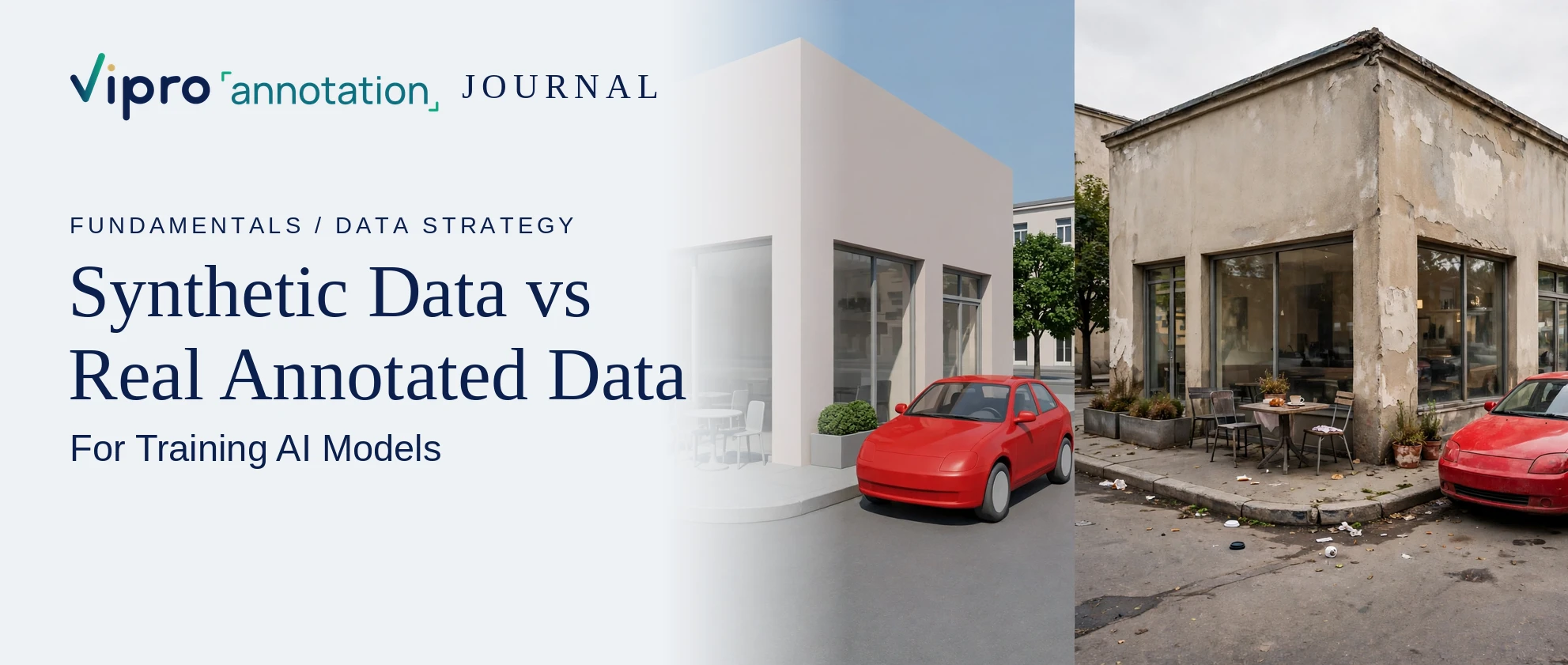
Models learn whatever patterns are in the data. If synthetic images have cleaner lighting, simpler textures or unrealistic sensor noise, the model may learn shortcuts that fail on real cameras. Closing the gap usually needs varied rendering, realistic sensor models and real data in the mix.
Good uses for synthetic data
- Rare or dangerous scenarios, such as near-collisions.
- Early prototyping before real data exists.
- Balancing under-represented classes.
- Privacy-sensitive settings where real images of people are hard to use.
Why real annotated data still matters
- Validation: the final test of a model should be on real data from the deployment setting.
- Edge cases: the real world produces cases nobody thought to simulate.
- Fine-tuning: a smaller set of real labeled data often fixes problems left by synthetic training.
A practical mix
- Use synthetic data to cover breadth and rare events.
- Label a focused set of real data from your actual cameras or sources.
- Hold out a real, high-quality test set that is never used for training.
- Measure where the model fails and add real labeled examples there.
Have a dataset in mind?
Start with a Free Calibration Pilot