

 Back to the journal
AI-Assisted Data Labeling: Pre-Labels, SAM and Human Review
Short answer: AI-assisted labeling uses a model to propose labels, and people review, correct and approve them. It speeds up simple, repetitive work such as drawing first-pass boxes or masks. It does not remove the need for humans: edge cases, new classes, ambiguous items and the final quality check still need trained reviewers.
Three common forms of AI assistance
| Form | How it works | Best for |
|---|---|---|
| Model pre-labeling | An existing model labels a batch; people correct it | Large volumes of familiar classes |
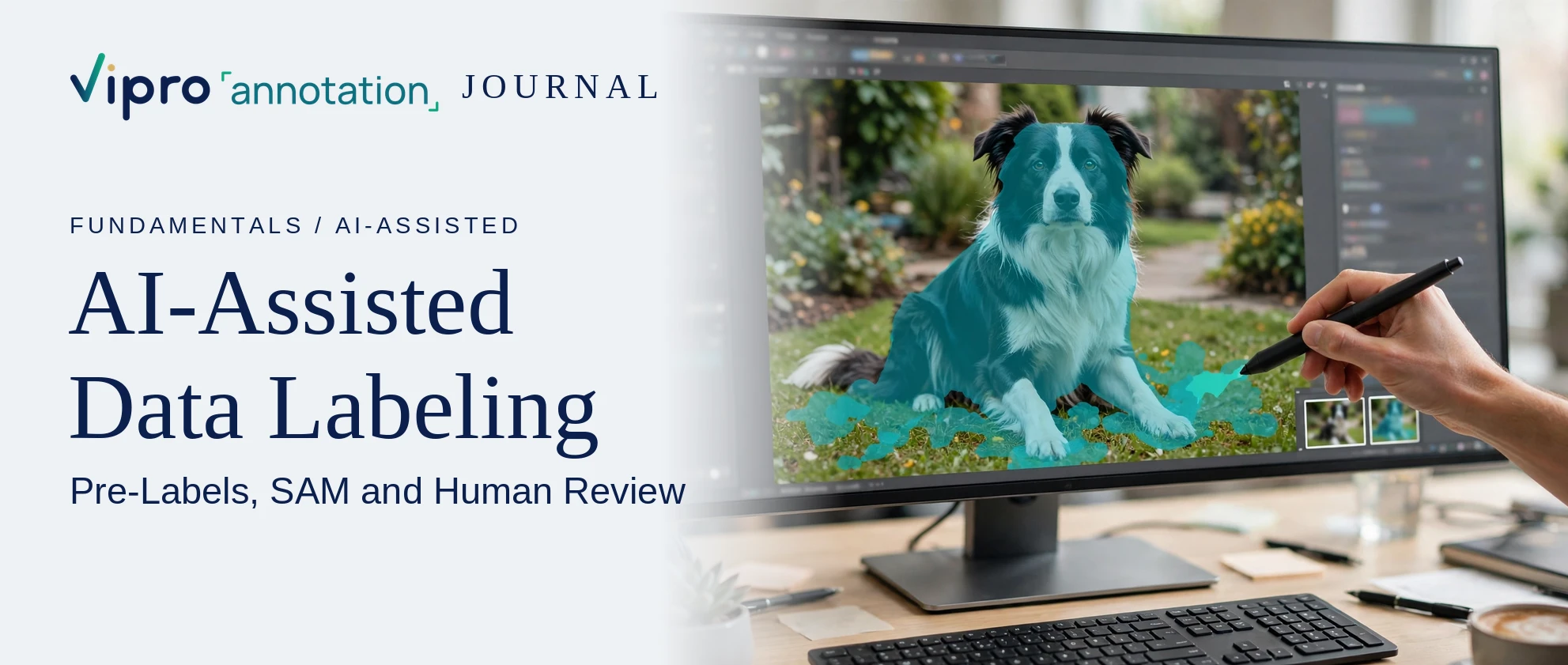
| Interactive tools | The annotator clicks a point or box and a model draws the mask | Fast, precise masks and polygons |
| Auto-tracking in video | A box drawn on one frame is propagated to the next frames | Object tracking across frames |
Segment Anything as an example
Meta's Segment Anything paper (Kirillov et al., ICCV 2023) describes a promptable segmentation model and the SA-1B dataset, with over 1 billion masks on 11 million licensed and privacy-respecting images. Its data engine moved through three stages: annotators first used a model-assisted tool, then the model proposed confident masks and annotators added the rest, and finally masks were generated automatically. It shows the pattern well: the model gets stronger as people correct it.
Where AI assistance helps
- Common, well-defined classes the model has seen before.
- Clear objects with sharp edges.
- Video tracking of steady, visible objects.
- Turning rough clicks into tight masks.
Where it fails without people
- Rare or new classes the model has never seen.
- Ambiguous items that depend on project rules, not just pixels.
- Small, blurred or hidden objects.
- Confident mistakes: pre-labels that look right but follow the wrong rule.
- Bias toward the model's own errors: if reviewers accept pre-labels too quickly, the model's mistakes become training data.
How to use pre-labels safely
- Measure pre-label quality on a sample before trusting it.
- Have reviewers check every item, or a defined sample, depending on risk.
- Track how often pre-labels are corrected, per class.
- Never let pre-labels go straight into training without review on high-risk tasks.
Sources
- Kirillov, A. et al. (2023). Segment Anything. ICCV 2023.
Have a dataset in mind?
Start with a Free Calibration Pilot