

 Back to the journal
Sports Video Annotation for AI
Before a sports model can follow the ball or recognise a shot, it has to be shown those moments frame by frame.
A sports model is only as good as the moments it was taught to see.
Sports analytics systems can track players, follow the ball and recognise shots automatically. Before they can do any of that, someone has to show them, frame by frame, what each of those things looks like.
This guide explains what sports video annotation involves, which label types are used, where the hard cases appear, and how to plan a project that produces data your model can trust.
What sports video annotation is
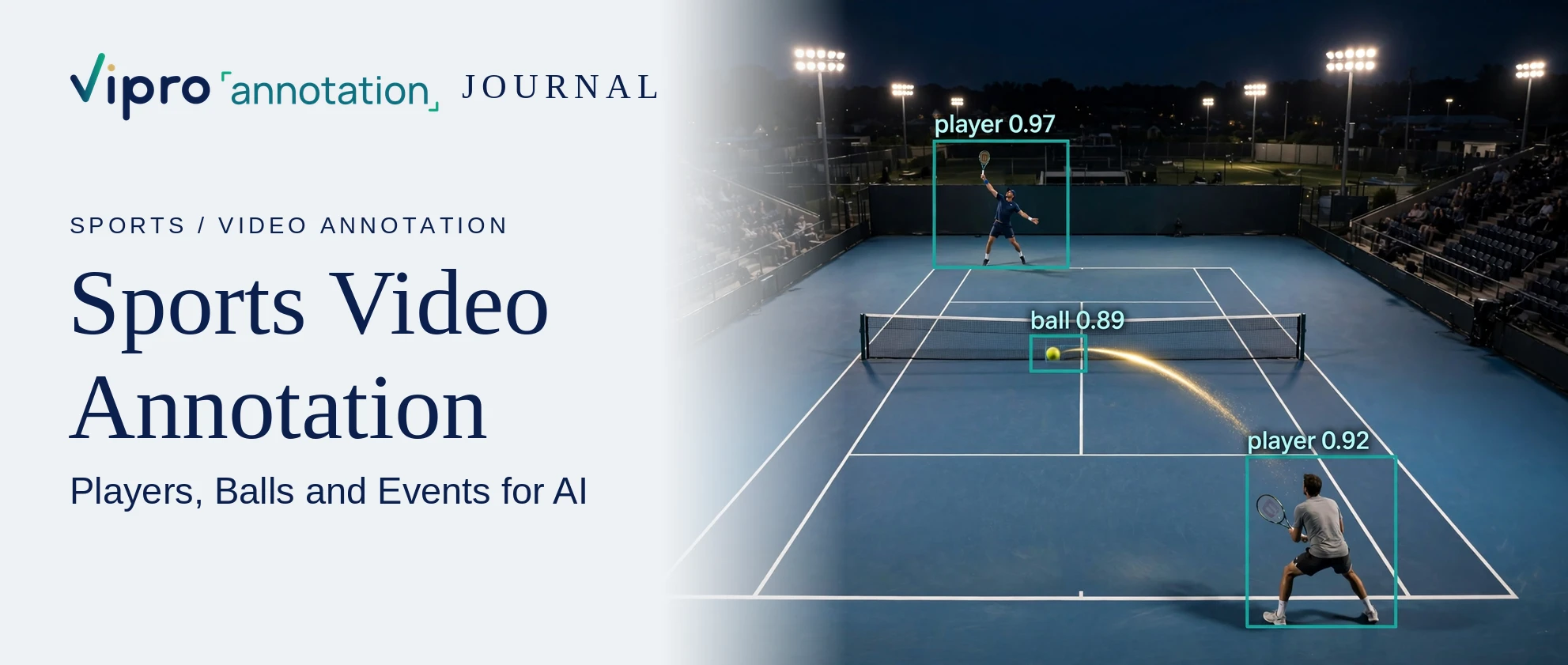
Sports video annotation turns match footage into structured training data. Annotators mark players, equipment and the ball in each frame, and label the events that matter, such as a serve, a shot or a bounce.
The result is a dataset a computer vision model can learn from, so it can later analyse new matches without human help.
The label types sports projects use
Bounding boxes: mark the player, racket or ball in each frame.
Keypoints: place points on joints such as shoulders, elbows and knees, so the model can learn body pose and technique.
Object tracking: keep the same identity on a player or ball across frames, even when they move fast or leave the view.
Event classification: label moments in time, such as the type of shot or where the ball lands.
Where sports footage gets difficult
Sports footage is harder than most video because everything moves quickly. A few situations cause most disagreements between annotators:
Motion blur: a fast ball or racket can smear across the frame. The guideline must say where the box goes.
Occlusion: players hide each other, or the net hides the ball. Rules are needed for partly visible objects.
Event boundaries: deciding the exact frame where a shot starts or a bounce happens needs a written definition.
Small objects: a ball can be just a few pixels wide in a wide camera shot.
Writing these decisions down before scaling is what keeps labels consistent across hundreds of thousands of frames.
Keeping quality consistent at scale
Large sports datasets are labelled by many people over many weeks. Consistency comes from a clear guideline, a pilot on the hardest clips, and review of every batch before delivery.
When a new kind of unclear case appears, it should become a written rule that every annotator follows from then on.
Where VIPRO can help
Video annotation services: tracking and event labelling across frames.
Image annotation services: boxes, polygons and keypoints on still frames.
Industries we work in: sports, manufacturing, smart cities and more.
Start with the hard frames
The clips that cause arguments are the ones that decide model quality. Testing them first saves rework later.
VIPRO Annotation starts every sports project with a pilot on your own footage. Get in touch to plan yours.
Have a dataset in mind?
Let’s talk