

 Back to the journal
Egocentric Video Annotation for AI
Footage from a head-mounted camera sees the world the way the wearer does. Teaching a model to understand it starts with careful labels.
An egocentric model learns to see through someone else's eyes, one labeled frame at a time.
Smart glasses, AR headsets, home robots and assistive devices all need to understand what a person is doing from that person's own point of view. The footage they learn from is egocentric video: video recorded by a camera worn on the head, chest or wrist.
This guide explains what egocentric annotation is, which label types it uses, where first-person footage gets difficult, and how to plan a project that produces training data your model can trust.
What egocentric annotation is
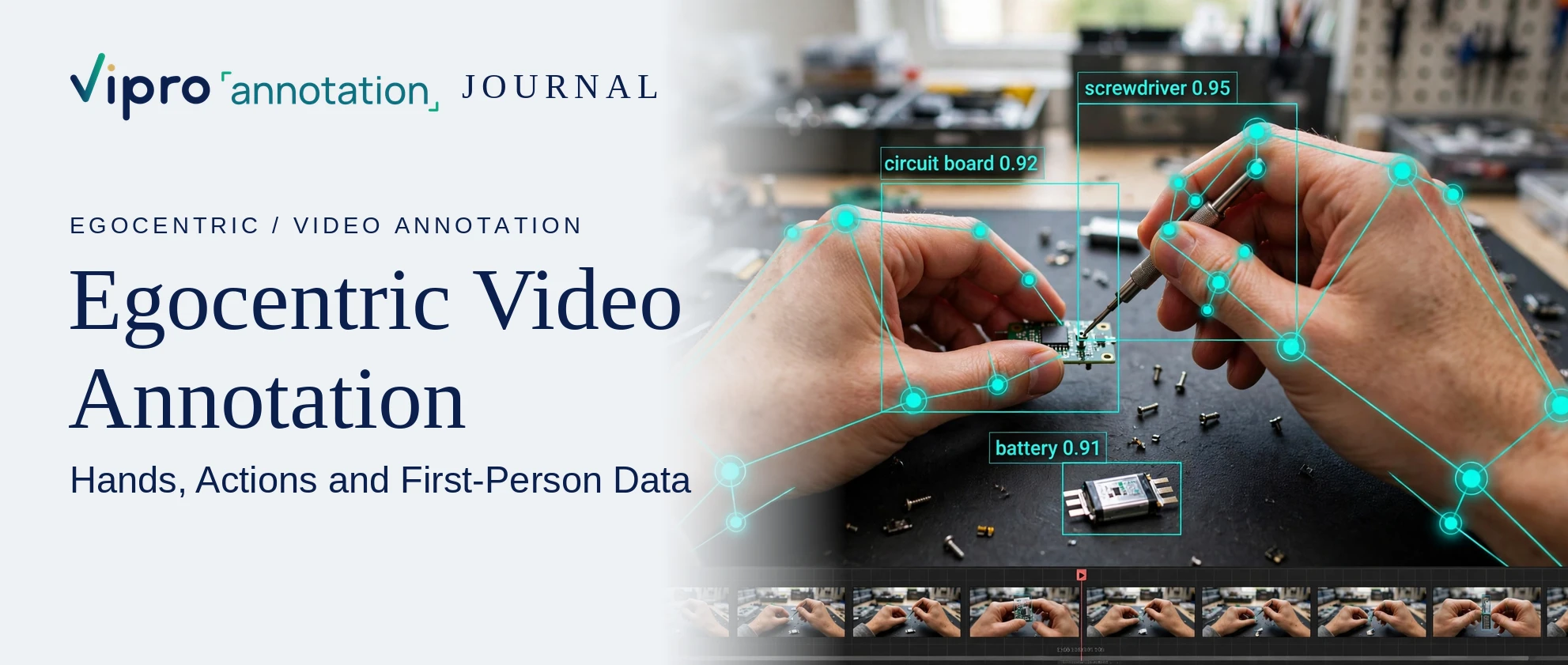
Egocentric annotation, also called first-person video annotation, turns wearable-camera footage into structured training data. Annotators mark the wearer's hands, the objects they touch, and the actions they perform, frame by frame and over time.
Unlike a fixed camera watching a scene, the egocentric camera moves with the person. The hands are often the most important thing in view, and the activity is the story the model has to learn.
The label types egocentric projects use
Hand keypoints: points on the wrist and finger joints so the model can learn hand pose and grip.
Bounding boxes and masks: outline the objects in use, such as a cup, a tool or a phone.
Hand-object interaction: record which hand is touching which object, and when contact starts and ends.
Action segmentation: split a clip into steps such as pick up, cut and place, each with a start and end frame.
Object tracking: keep the same identity on an object as the wearer's head turns away and back.
Where first-person footage gets difficult
Egocentric video breaks many assumptions of normal video annotation. These situations cause most disagreements between annotators:
Fast head motion: the whole frame blurs when the wearer turns. The guideline must say when a label is skipped or kept.
Self-occlusion: a hand covers the object it is holding, or one hand hides the other.
Objects leaving the view: an item drops below the camera and comes back. Rules decide whether it keeps the same identity.
Action boundaries: deciding the exact frame where reaching ends and grasping begins needs a written definition.
Left and right hands: hands cross and swap sides of the frame, so handedness must be checked, not assumed.
Writing these decisions down before scaling keeps labels consistent across long recordings and many annotators.
What egocentric training data is used for
AR and smart glasses: recognising what the wearer is holding or doing, to show the right help at the right time.
Robotics and embodied AI: learning manipulation skills from human demonstrations recorded first-person.
Assistive technology: helping devices understand daily activities in the home.
Workplace training and safety: following procedure steps in assembly, maintenance or lab work.
Keeping quality consistent at scale
Egocentric datasets are often long, continuous recordings. Consistency comes from a clear guideline, a pilot on the hardest clips, and review of every batch before delivery.
When a new kind of unclear case appears, such as an object only partly in view, it should become a written rule that every annotator follows from then on.
Where VIPRO can help
Video annotation services: tracking, action and event labeling across frames.
Image annotation services: keypoints, boxes and masks on single frames.
Industries we work in: egocentric video, sport, manufacturing, LiDAR & 3D and more.
How to choose a data annotation provider: questions to ask before you start.
Start with the hardest clips
The moments where hands hide objects or the camera spins are the ones that decide model quality. Testing them first saves rework later.
VIPRO Annotation starts every egocentric project with a pilot on your own footage. Get in touch to plan yours.
Egocentric video annotation for robotics and manufacturing
First-person video shows a task the way the worker or robot sees it: hands in front of the camera, tools moving in and out of view, and objects changing state. That viewpoint is why egocentric data is used to teach robots manipulation skills and to help factories understand assembly steps, safety behavior and process time.
Typical goals include:
- Robot learning from human demonstration: which hand grasps which object, in what order, and how.
- Assembly verification: whether each step happened, in sequence, and how long it took.
- Safety and ergonomics: PPE use, unsafe reaches, and hand positions near machinery.
- Skill assessment: how an expert performs a step compared with a beginner.
What gets annotated in egocentric video
| Layer | What it captures |
|---|---|
| Action segments | Start and end time of each action, often as verb + noun ("pick screw", "tighten bolt") |
| Hand-object interaction | Which hand touches which object, contact start and end, grasp type |
| Hand keypoints | Joint positions of each hand (21-point layouts are common) |
| Object boxes or masks | Tools and parts, tracked across frames |
| Object state changes | Before and after states ("open" to "closed", "empty" to "full") |
| Narrations | Short plain-language descriptions of what the wearer is doing |
| Step / keystep labels | Which step of a known procedure is happening |
Public egocentric datasets worth knowing
These research datasets show the scale and label types used in the field:
- Ego4D (CVPR 2022): 3,670 hours of daily-life activity video captured by 931 unique camera wearers from 74 worldwide locations and 9 countries. Its benchmarks cover episodic memory, hand-object manipulation, audio-visual conversation, social interactions and activity forecasting.
- Ego-Exo4D (CVPR 2024): 740 participants from 13 cities performed skilled activities in 123 scene contexts, giving 1,286 hours of video recorded from both first-person and third-person views, with audio, eye gaze, 3D point clouds, camera poses, IMU and paired language descriptions. Benchmarks include fine-grained activity understanding, proficiency estimation, cross-view translation and 3D hand/body pose.
- EPIC-KITCHENS-100: 100 hours, 20 million frames and about 90,000 actions in 700 videos recorded with head-mounted cameras in 45 environments.
Private robotics and factory projects are usually smaller but need tighter, task-specific rules.
Hard parts of egocentric annotation
- Camera motion: head movement causes blur and fast viewpoint changes.
- Occlusion: hands hide the object being manipulated.
- Action boundaries: when exactly does "pick" end and "place" begin?
- Small objects: screws, clips and connectors may be only a few pixels.
- Long videos: consistent labels across many minutes of footage.
Each needs a written rule with examples, and temporal agreement (tIoU) checks on a sample to keep action boundaries consistent between annotators.
Planning an egocentric annotation project
- Define the action vocabulary (verbs and nouns) before labeling starts.
- Decide boundary rules: first frame of contact or first frame of motion.
- Choose which layers you really need; not every project needs hand keypoints.
- Pilot on your hardest clips, such as cluttered benches and fast hand motion.
- Measure temporal agreement and review disagreements to update the rules.
Sources
- Grauman, K. et al. (2022). Ego4D: Around the World in 3,000 Hours of Egocentric Video. CVPR 2022.
- Grauman, K. et al. (2024). Ego-Exo4D: Understanding Skilled Human Activity from First- and Third-Person Perspectives. CVPR 2024.
- Damen, D. et al. (2022). Rescaling Egocentric Vision: Collection, Pipeline and Challenges for EPIC-KITCHENS-100. International Journal of Computer Vision. arXiv:2006.13256.
Have a dataset in mind?
Let’s talk