

 Back to the journal
Teleoperation Data Annotation for Robot Learning
Short answer: teleoperation data annotation means adding structure to recordings of robots controlled remotely by a person. The client supplies the recordings, usually camera video plus the robot's state and command logs. Annotators then mark task phases, sub-task boundaries, success or failure, objects and contact events, and write short task descriptions, so the data can be used to train robot learning models. VIPRO annotates these recordings; it does not capture teleoperation data.
What teleoperation data is
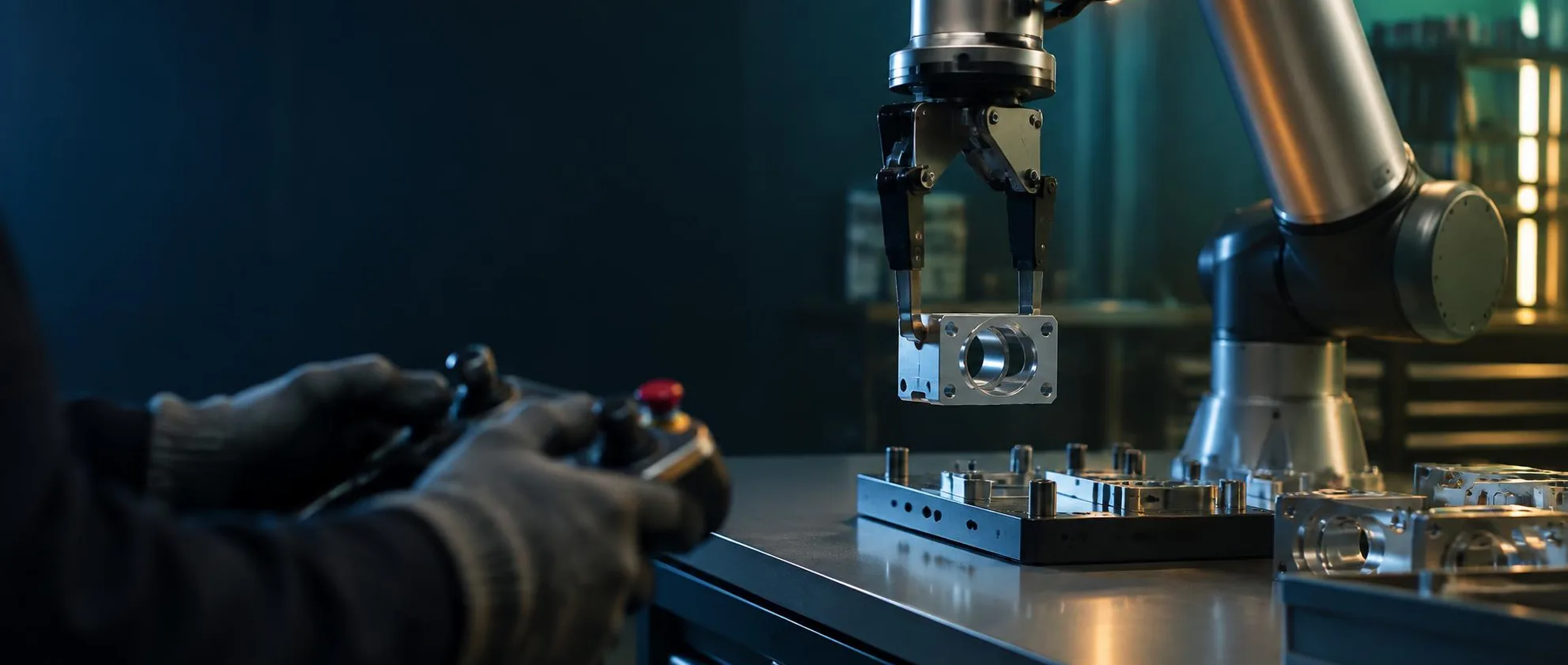
In teleoperation, a person controls a robot from a distance, using a joystick, a leader arm, a VR headset or a similar interface. While they work, the system records what the robot sees and does. A typical recording, often called an episode, includes:
- Video from one or more cameras, such as a head camera, a wrist camera and fixed scene cameras.
- Robot state: joint positions, gripper opening and sometimes forces.
- Commands: what the operator asked the robot to do at each moment.
- Metadata: task name, operator, date, setup.
Because the robot itself did the task, the recording is already in the robot's own body and sensors. That makes teleoperation data valuable for imitation learning, but raw episodes still need labels to be easy to search, filter and learn from.
Definitions used in this guide
- Episode: one recorded attempt at one task, from start to stop.
- Operator: the person controlling the robot.
- Task phase (sub-task): a named step inside an episode, such as approach, grasp or place.
- Intervention: a moment where the operator pauses, corrects or restarts part of the task.
- Outcome label: success, failure or partial success for the episode or a step.
- Time alignment: making sure video frames and robot logs share the same clock.
What gets labeled in teleoperation recordings
| Label | What it marks | Why it helps |
|---|---|---|
| Episode description | The task in plain language | Links language to behaviour |
| Task phases | Start and end of each step | Shorter, reusable training examples |
| Outcome | Success, failure, partial | Filtering and weighting data |
| Interventions and retries | Pauses, corrections, restarts | Separating clean demonstrations from recoveries |
| Objects and contact | Objects handled, contact start and end | Grounding and grasp learning |
| State changes | Object placed, opened, closed | Clear goal conditions |
| Quality flags | Dropped frames, blur, sync problems | Excluding unusable episodes |
A worked example: a bin-picking episode
A 60-second episode shows a teleoperated arm picking two parts from a bin and placing them on a tray.
- Check alignment. The annotator confirms that the gripper-close event in the robot log matches the frame where the gripper visibly closes. If not, the offset is flagged.
- Describe the episode. "Pick two parts from the bin and place them on the tray."
- Mark phases. Approach part 1, grasp, lift, move, place, release; then the same for part 2.
- Mark an intervention. The first grasp slips and the operator retries. The failed grasp and the retry are labeled separately.
- Outcome. Episode success; first grasp attempt failure.
- Review. A second person checks phase boundaries, the intervention label and the alignment note.
Labeling the retry separately lets the team choose later whether to train on clean demonstrations only, or to include recovery behaviour.
Common mistakes
- Ignoring clock offsets. Labels placed on video can be off from the robot log if the streams are not aligned.
- Treating retries as normal steps. Mark them so they can be filtered or used on purpose.
- Vague phase boundaries. Tie each boundary to a visible or logged event, such as gripper close.
- Inconsistent task text. Use a short style guide and a shared vocabulary.
- Not flagging bad episodes. Dropped frames or sync errors should be labeled, not silently skipped.
Episode, phase and frame: choosing the level of detail
Teleoperation projects can label at three levels, and most use more than one.
- Episode level: one description and one outcome per episode. Fast, and enough to search and filter a large collection.
- Phase level: task steps with start and end times. Useful for training shorter skills and for finding which steps fail.
- Frame level: objects, hands or keypoints in individual frames. The most detailed and the most effort, used where the model needs spatial grounding.
A common plan is to label all episodes at the episode level, a large share at the phase level and a smaller, targeted share at the frame level.
How quality is checked
Review covers text, time and space. A reviewer checks that descriptions match the episode, that phase boundaries follow the written definitions and that frame-level labels follow the geometry rules. Agreement on phase timing can be measured with temporal IoU, the overlap between two annotators' segments divided by their combined span. Two-stage review, with an annotator self-check followed by an independent reviewer, keeps labels consistent across operators, tasks and recording days. Recurring disagreements lead to versioned guideline changes.
Working with large episode collections
Teleoperation collections grow quickly, and not every episode needs the same treatment. Teams often start by labeling a sample to see which tasks and failure types are common, then decide where deeper labels pay off. Keeping episode IDs, camera names and log fields stable across deliveries makes it much easier to merge labels back into the training pipeline.
Typical delivery structure
Labels are usually delivered as structured files keyed by episode ID and timestamp or frame number, so they can be joined back to the video and robot logs. Each episode record holds a description, an outcome, a list of phases with start and end times, any interventions, and quality flags. Frame-level labels, where used, follow the agreed geometry rules and keep stable object IDs across frames.
Checklist for buyers and ML engineers
- What does each episode contain: which cameras, which logs, which metadata?
- How are video and logs time-aligned, and who fixes offsets?
- What is the list of task phases, with start and end definitions?
- How are interventions, retries and failures labeled?
- Is there a style guide for episode and step descriptions?
- Which quality flags should be recorded?
- What export format does your training pipeline read?
How VIPRO fits in
VIPRO annotates teleoperation recordings and other data the client supplies. It does not capture teleoperation data, supply hardware, run simulation or train models. For robot learning projects, VIPRO labels task phases, action segments, state changes, objects, hands and keypoints, and writes clip descriptions, with two-stage QA. Read more on robotics and physical AI data annotation and egocentric video annotation, and test the rules with a calibration pilot.
Frequently asked questions
What is teleoperation data?
It is the recording made while a person controls a robot remotely, usually including video from the robot's cameras, the robot's joint and gripper state, and the operator's commands.
Why annotate teleoperation recordings?
Raw episodes are long and mixed: they include setup time, retries and failures. Labels such as task phases, outcomes and interventions make the data searchable and let teams train on the right parts.
Should failed attempts be removed?
Not automatically. Labeled failures and recoveries can be useful. Mark them clearly so the team can decide later whether to include them.
How are video and robot logs kept in sync?
The recordings should share a clock or have known offsets. Annotators can check alignment at clear events, such as the gripper closing, and flag any offset for the engineering team.
Does VIPRO record teleoperation data?
No. VIPRO annotates teleoperation recordings the client supplies and does not run data capture.
Have a dataset in mind?
Start with a Free Calibration Pilot